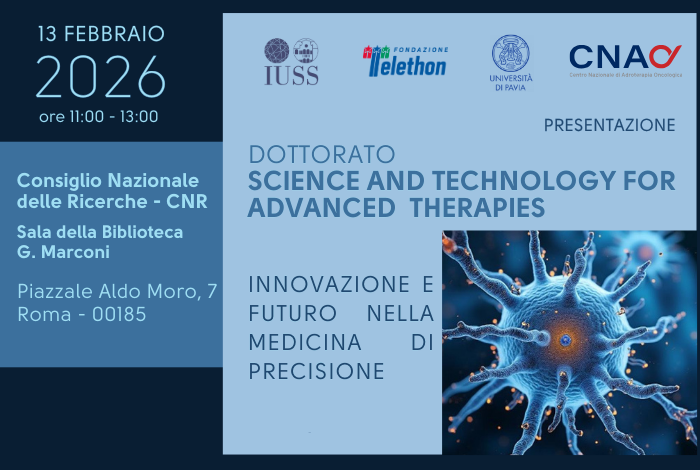
On 13 February 2026, the National PhD programme in “Science and Technology for Advanced Therapies” (STAT) was presented in Rome at the CNR Headquarters (Sala della Biblioteca G. Marconi, Piazzale Aldo Moro 7). The event was promoted by IUSS Pavia in collaboration with Fondazione Telethon, the University of Pavia, and the Fondazione CNAO.
The meeting provided an opportunity for dialogue among universities, research organisations, and institutional and industrial stakeholders, outlining the vision, structure, and training opportunities of a doctoral pathway focused on advanced therapies and precision medicine.
A national and international network supporting the programme
Supported by the Italian Ministry of University and Research (MUR), the STAT PhD is built on a broad network of academic and research partners, including (among others) IUSS Pavia (coordinating institution), the University of Pavia, the University of Turin, the University of Trento, and the University of Eastern Piedmont, together with CNR and Fondazione CNAO, and with contributions from industrial and international partners such as Philochem/Philogen and Boston Children’s Hospital.
Training pathway and curricula
During the presentation, the multidisciplinary nature of the STAT PhD was highlighted, structured around three curricula:
- Hadron Therapy and Advanced Biophysical Therapies, focusing on advanced physical technologies (including hadron therapy) and competencies in therapeutic devices, bioengineering, and risk analysis;
- Gene and Cell Therapies, dedicated to the design and clinical translation of gene and cell therapies, with a focus on advanced genetic engineering techniques;
- Biomolecular and Biotechnological Sciences, integrating biomolecular and biotechnological expertise with a strong emphasis on experimental research and the development of innovative methodologies for health.
A strategic opportunity for the bioengineering community
The STAT PhD aims to train profiles capable of working in highly interdisciplinary contexts where biomedicine, biology, engineering, and physics converge, alongside cross-cutting dimensions such as ethics, law, and the economics of technology. In this sense, the initiative stands out as a highly relevant opportunity for the bioengineering community, fostering connections among competencies, infrastructures, and innovation ecosystems.
For further information and materials, please contact the dedicated office at: phd-stat@iusspavia.it.