Biomechanics of Human Plantar Skin: Experimental and Constitutive Analysis
Authors: Chiara Giulia Fontanella, Sofia Pettenuzzo, Alice Berardo, Elisa Belluzzi, Assunta Pozzuoli, Pietro Ruggieri, Emanuele Luigi Carniel
Keywords
Foot; Human plantar skin; Mechanical tests; Constitutive model; Ex vivo analysis.
Summary
Plantar skin is a highly specialised tissue which protects the foot from injuries and adapts to external stresses. However, it can be subjected to diabetic plantar ulcers, which are among the most difficult and costly wounds to treat. Although this is a crucial topic, few studies have focused on the mechanical properties of foot skin and how disease alters them. In this context, this work aims to fully describe the mechanical behavior of plantar skin through experiments and constitutive
analysis.
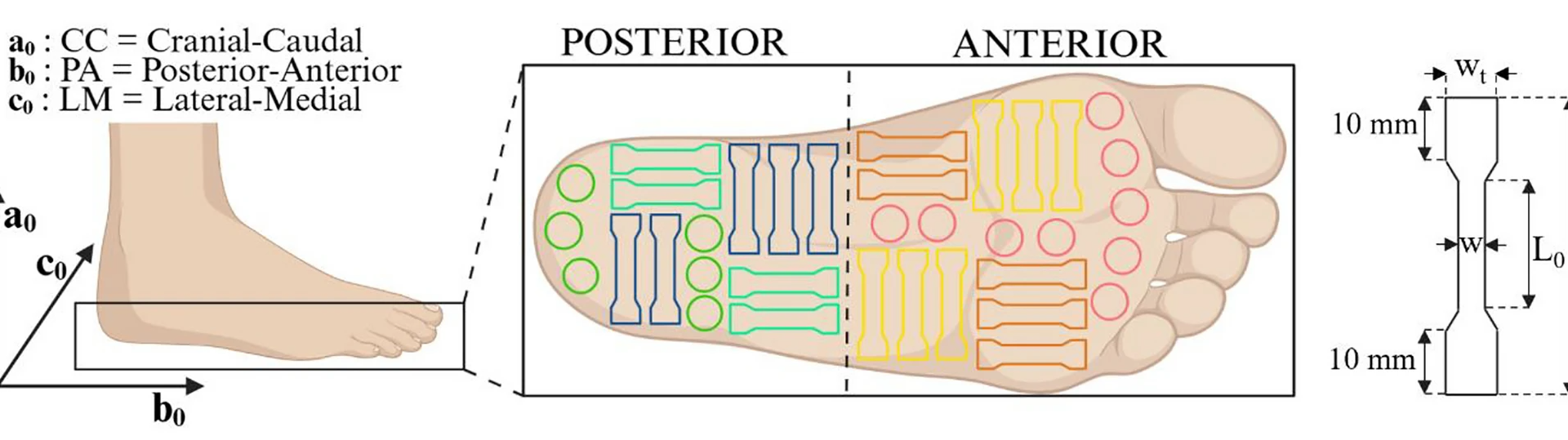
Different experimental tests (failure tensile tests, unconfined compression at different strain rates, stress relaxation tests) were conducted on human plantar skin samples cut along the posterior-anterior (PA), lateral-medial (LM), and cranialcaudal (CC) directions. Then, experimental results were used to identify, through an inverse analysis, the parameters of the anisotropic visco-hyperelastic constitutive model adopted to describe the skin’s mechanical response.
Plantar skin’s non-linear, anisotropic, and time-dependent behavior, with differences between the anterior and posterior foot’s regions. In addition, the constitutive model adopted is able to capture the mechanical behavior of the plantar skin
Failure tensile tests showed that PA directions exhibited higher elastic modulus than LM directions in both posterior (22.05 vs 12.91 MPa) and anterior (17.39 vs 12.82 MPa) regions, while the unconfined compression tests revealed that compressive elastic moduli in the posterior region increased with increasing strain rates.
The proposed model provides new insights into the mechanics of plantar skin, being a valuable tool for applications such as diagnosing skin diseases and developing skin substitutes.
For futher details, here is the link for the open access publication.