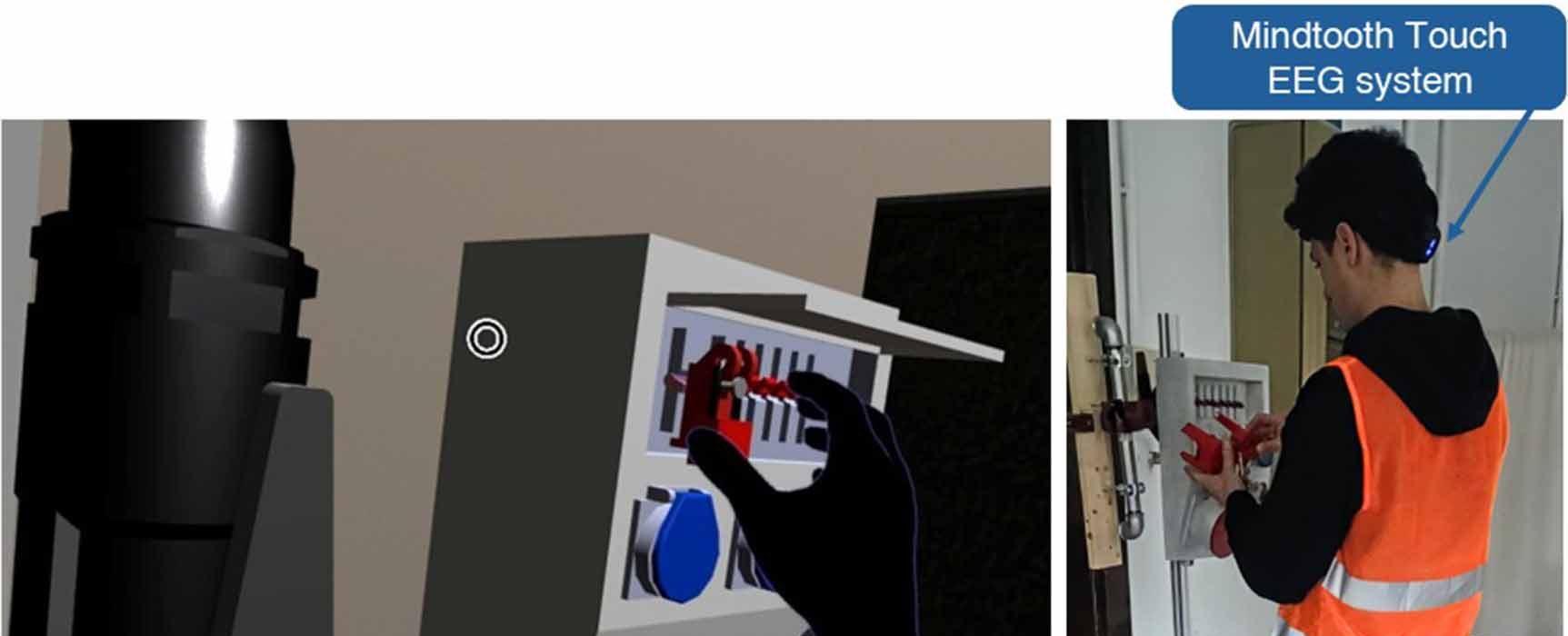
A novel neurophysiological approach to evaluate the impact of virtual training on skills acquisition
Authors: Vincenzo Ronca, Rossella Capotorto, Sara Buonocore, Francesca Massa, Giuseppe Di Gironimo, Raffaele De Amicis, Stefano Papa, Luca Mattioli, Eduardo Palermo, Luciano Di Donato, Daniela Freda, Marco Pirozzi, Alessandra Ferraro, Gianluca Di Flumeri, Andrea Giorgi, Gianluca Borghini, Pietro Aricò
Keywords
EEG; principal component analysis; training.
Summary
The objective evaluation of training effectiveness remains a significant challenge, particularly when comparing traditional physical training with virtual reality (VR)-based approaches. This study introduces a novel neurophysiological measure, the Cognitive Training Index (CTI), derived from electroencephalographic (EEG) signals to monitor cognitive adaptation throughout the learning process.
The research investigated training activities involving industrial maintenance operations in confined spaces, examining operational performance, perceived workload, and participants’ brain activity. The CTI was developed by integrating six EEG-based neurometrics through multivariate analysis, aiming to identify neurophysiological changes associated with skill acquisition.
Results showed a significant increase in CTI across training repetitions, accompanied by reductions in procedural errors and subjective workload. The index was particularly sensitive to task phases involving greater learning demands, demonstrating its ability to capture meaningful aspects of neurocognitive adaptation.
The study presents an innovative approach to assessing cognitive changes during training, providing a foundation for comparing physical and virtual training methodologies and supporting the future development of personalized and adaptive training systems informed by neurophysiological measurements.
For further details, here is the link for the open access publication.