Challenges of health data standard adoption and usage: a systematic review
Authors: Alberto Marfoglia, Valerio Antonio Arcobelli, Serena Moscato, Antonino Amedeo La Mattina, Sabato Mellone, Antonella Carbonaro
Keywords
Health data standard ; Interoperability ; Health informatics.
Summary
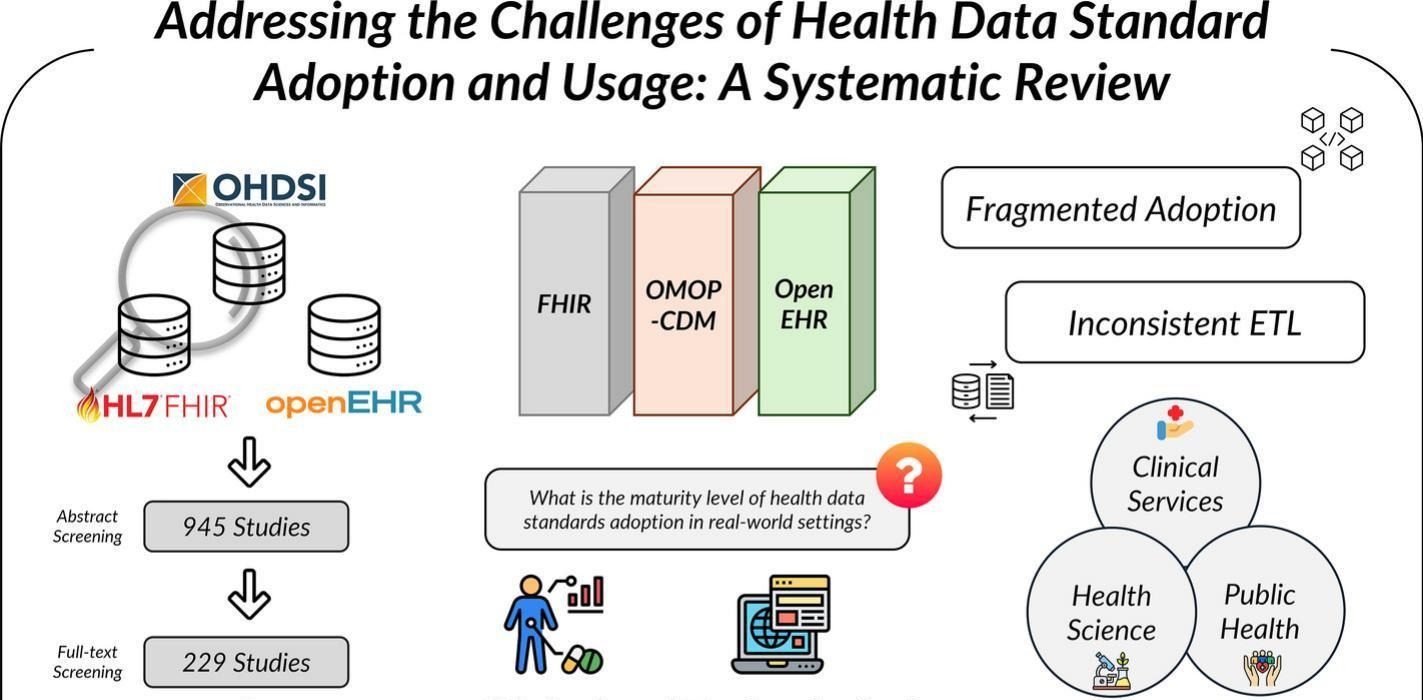
The aim of this study is to explore the adoption and practical implementation of the three most widely used health data standards (FHIR, OMOP-CDM and openEHR), in order to assess their level of maturity in terms of application and integration into clinical and research practice.
We conducted a systematic review of the literature published in PubMed, Cochrane, Scopus, Web of Science and IEEE Xplore from 2021 to 2024. Following deduplication and screening, 99 studies were included, from which we extracted information on the scale of implementation, ETL tools, standard coverage, and any standard extensions that had been implemented or proposed.
Of the 99 studies included, 57% use OMOP-CDM, 39% use FHIR and 8% use openEHR. Most applications relate to research contexts (87%) and focus on data reuse (47%) or clinical decision support (23%). OMOP-CDM is preferred for large-scale longitudinal research, whilst the implementation of FHIR often requires customisation, which complicates interoperability. OMOP-CDM offers powerful analytical tools but poses challenges in terms of mapping and data loss. The adoption of openEHR appears to be limited.
Although FHIR, OMOP-CDM and openEHR have great potential to improve system interoperability, their adoption remains fragmented. Each standard has specific strengths: data exchange for FHIR, analytical capabilities for OMOP-CDM, and data persistence for openEHR.
For further details, here is the link for the open access publication.