Femur Fracture Risk Assessment in Patients with Lytic Metastases Using CT-Based Finite Element Models and Bone Crack Simulations Technique
Authors: Davide Bentivoglio, Cristina Curreli, Barbara Dozza, Anna Mammone, Elisa Bruatto, Laura Campanacci, Antonino Amedeo La Mattina
Keywords
Femoral bone metastases; Patient-specific finite element models; Crack propagation; Elements deactivation.
Summary
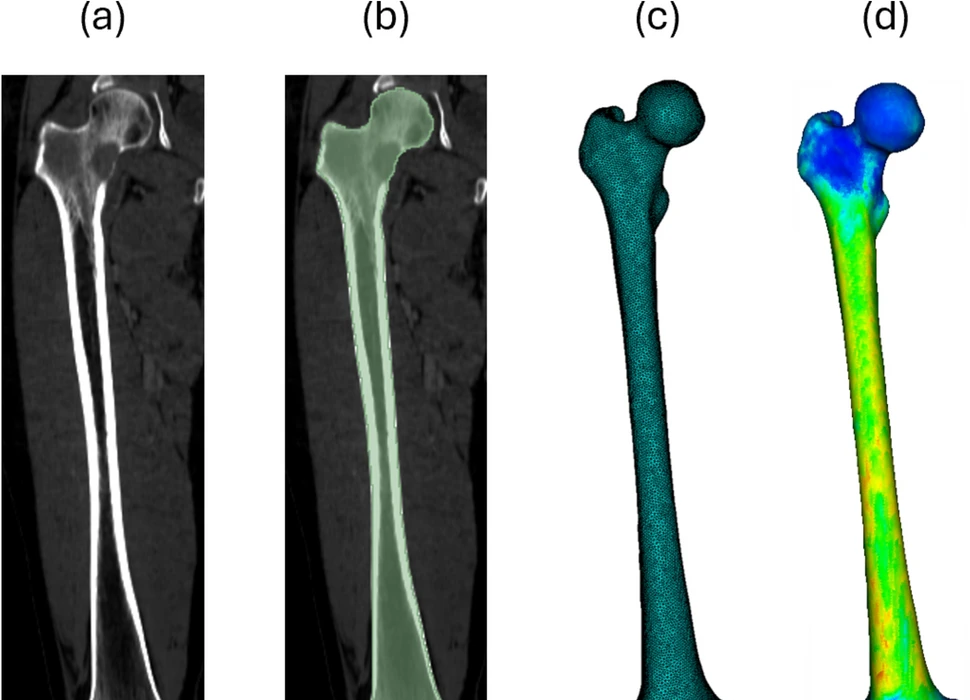
Metastases to the femur are a serious and common complication in patients with advanced solid tumours. The assessment of fracture risk is usually based on the Mirels score; however, this has limited specificity and often leads to unnecessary surgery. Finite element (FE) models have demonstrated superior accuracy, but current approaches vary widely in methodology and rarely capture the entire fracture process. This study investigates, for the first time, the use of a linear FE approach based on the incremental element deletion technique to simulate fracture initiation and propagation in femurs with lytic metastases.
A retrospective analysis was conducted on 24 patients with lytic femoral lesions, and the model results were compared with clinical outcomes. The stratification accuracy of the proposed approach was compared with that of the Mirels score, the clinical standard.
The simulations successfully replicated the fracture trajectories observed clinically and demonstrated a high ability to distinguish between patients at high and low risk of femoral fracture. The failure criterion based on the last load applied during crack propagation achieved the best diagnostic performance, with excellent sensitivity and specificity; however, the criterion based on fracture initiation showed comparable performance.
For further details, here is the link for the open access publication.