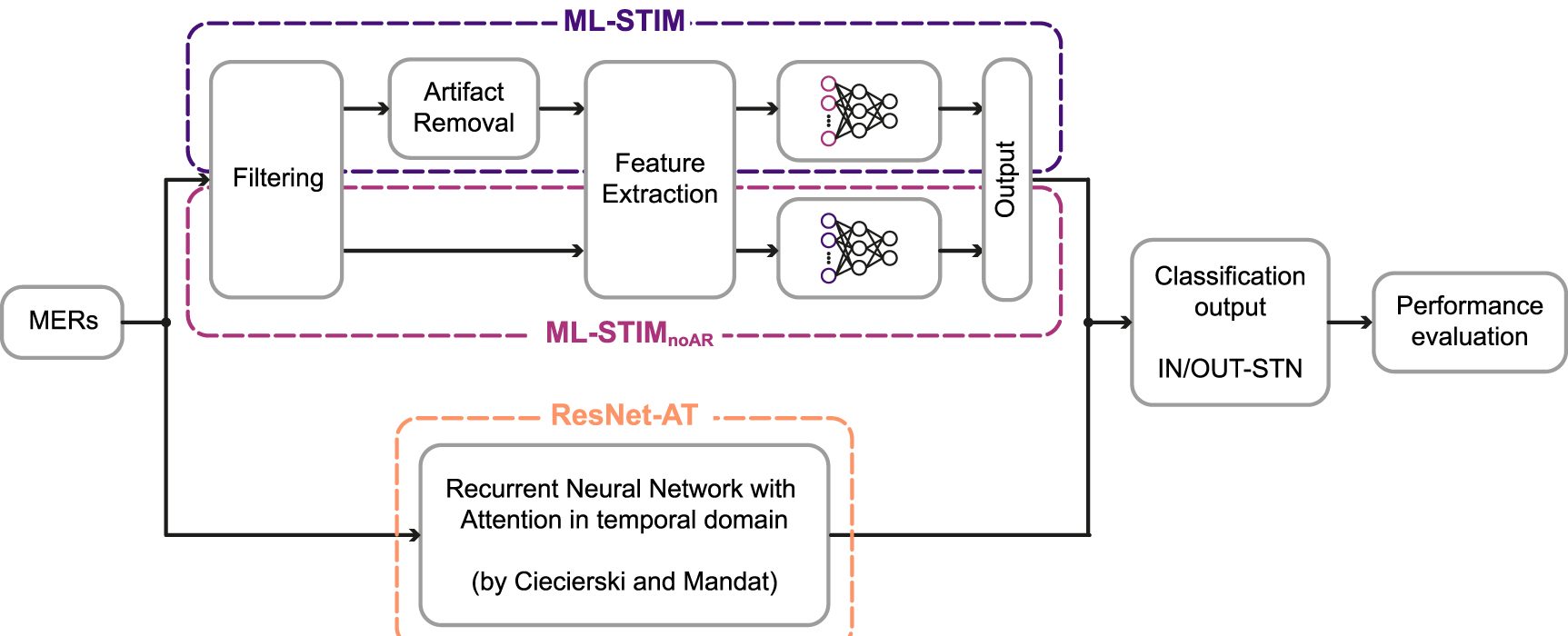
ML-STIM: Machine Learning for SubThalamic nucleus Intraoperative Mapping
Authors: Fabrizio Sciscenti, Valentina Agostini, Laura Rizzi, Michele Lanotte, Marco Ghislieri
Keywords
deep brain stimulation, STN-DBS, electrode placement, artifacts detection, real-time classification, multilayer perceptron, PD.
Summary
This study introduces ML-STIM, a machine learning pipeline designed to automate intraoperative identification of the subthalamic nucleus (STN) during Deep Brain Stimulation (DBS) surgery in Parkinson’s disease (PD) patients, addressing the limitations of manual analysis of microelectrode recordings (MERs). The pipeline integrates optimized artifact removal, feature extraction, and classification using a multilayer perceptron, and was trained and validated on one dataset while tested on an independent dataset to assess generalizability. ML-STIM achieved high classification accuracy (about 88% on the training dataset and 84% on the independent set), significantly outperforming a state-of-the-art deep learning model, while maintaining real-time processing capability (around 140 ms per recording). The results highlight its effectiveness, robustness across centers, and computational efficiency, supporting its potential as a reliable and interpretable tool for real-time STN localization in DBS procedures.
For further details, here is the link for the open access publication.