o-CLEAN: a novel multi-stage algorithm for the ocular artifacts’ correction from EEG data in out-of-the-lab applications
Authors: Vincenzo Ronca, Gianluca Di Flumeri, Andrea Giorgi, Alessia Vozzi, Rossella Capotorto, Daniele Germano, Nicolina Sciaraffa, Gianluca Borghini, Fabio Babiloni, Pietro Aricò
Keywords
EEG; ocular artefacts; signal processing.
Summary
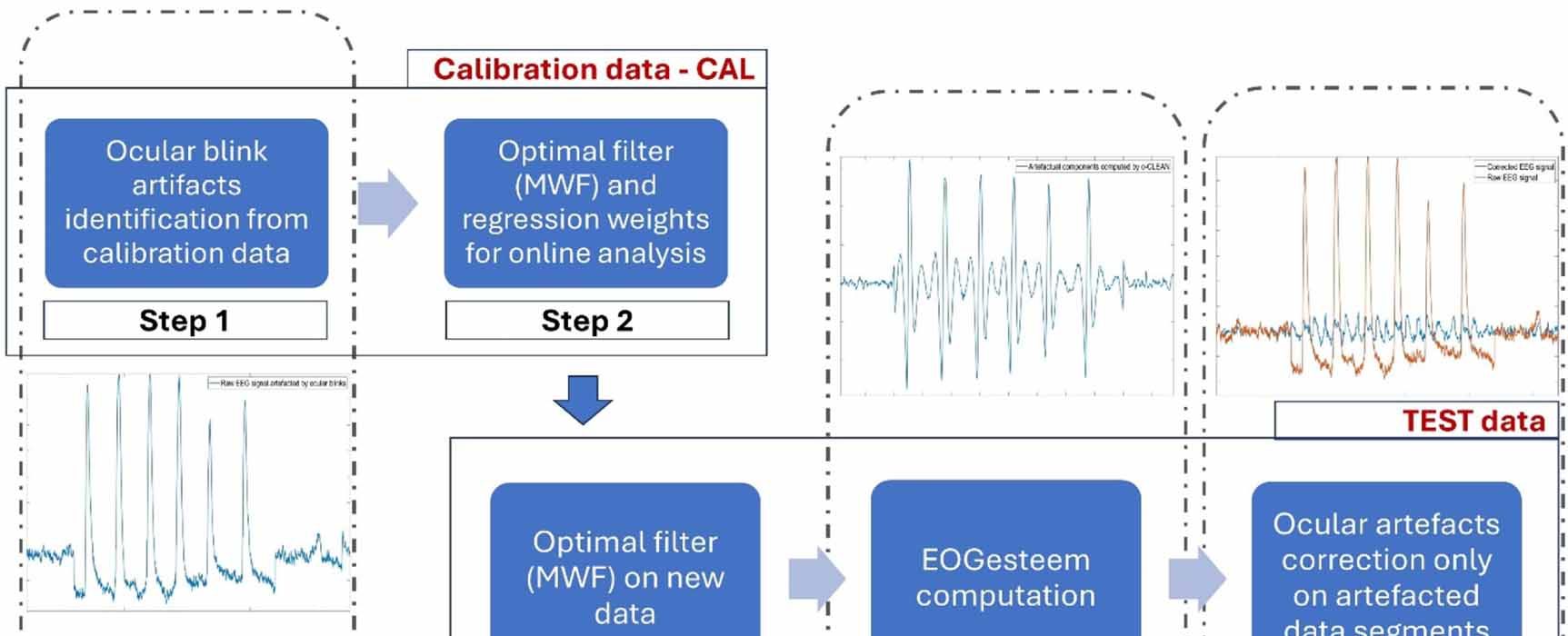
Electroencephalography (EEG) provides a non-invasive means of monitoring brain activity, but signal quality can be substantially affected by artefacts generated by eye movements, particularly blinks. This issue becomes especially relevant in out-of-the-lab applications, where wearable EEG systems often rely on a limited number of electrodes and do not include dedicated electrooculography (EOG) channels. The study introduces o-CLEAN, a novel multi-stage algorithm designed to identify and correct ocular artefacts while preserving the underlying EEG information. The method was compared with established state-of-the-art approaches by evaluating two complementary aspects: its ability to correct EEG signals during blink occurrences (IN-Blink) and its ability to preserve neural activity when no ocular artefact is present (OUT-Blink). Results showed that o-CLEAN performs at least as reliably as widely validated techniques in correcting blink-related contamination, while providing particularly strong performance in preserving EEG information, especially when only a small number of channels is available. Because the algorithm does not require a dedicated EOG template and is compatible with online processing, it is particularly suited to wearable EEG systems and recordings performed in realistic environments. The proposed approach therefore addresses an important challenge in EEG bioengineering and supports the development of robust neuroengineering and applied neuroscience solutions for real-world applications.
For further details, here is the link for the open access publication.